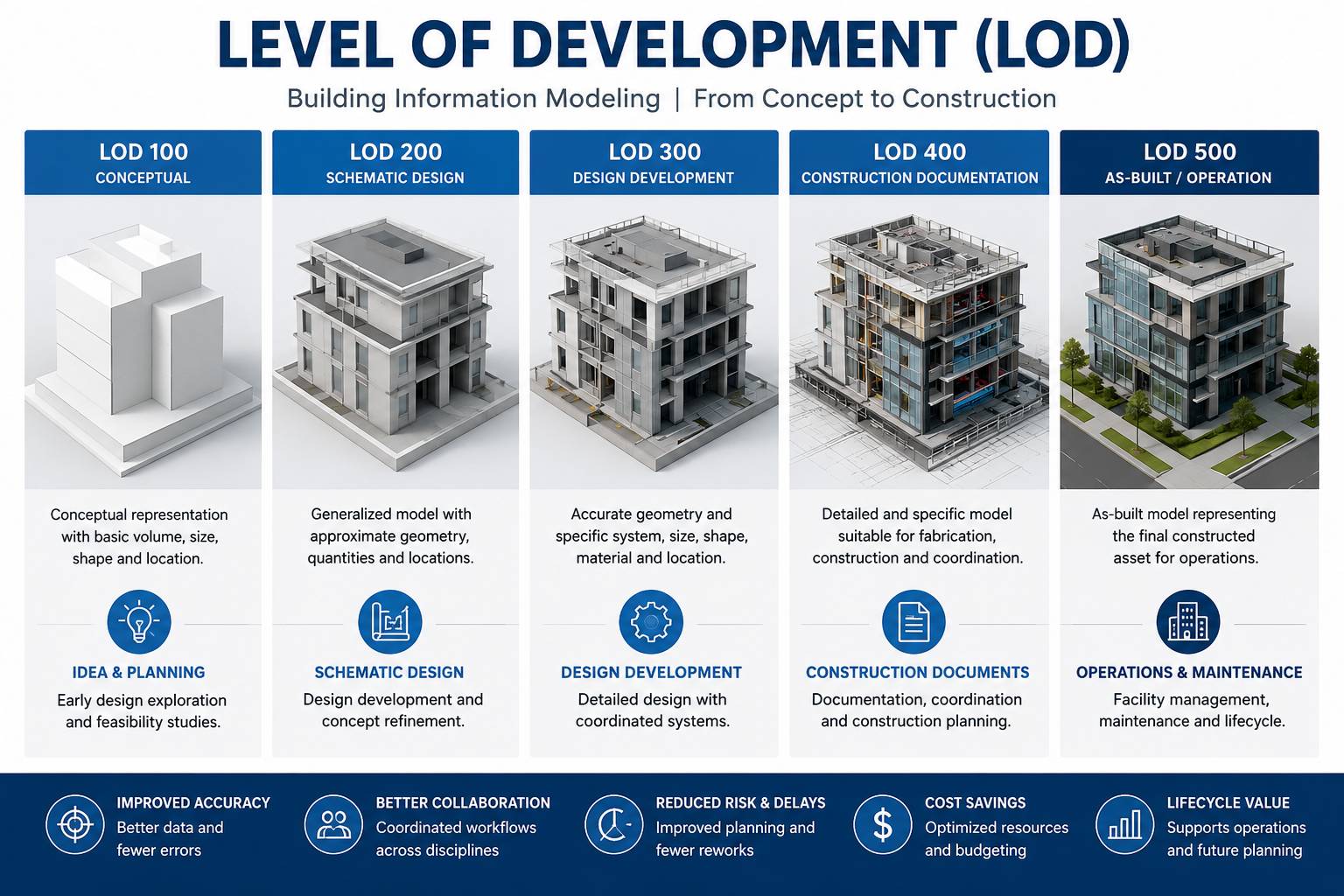

The architecture, engineering, and construction (AEC) industry is undergoing its digital transformation, and the Level of Development (LOD) in Building Information Modeling is one of the most important frameworks enabling that transformation. LOD is the level of development (information, detail, and reliability) that is contained within a BIM model at each stage of a project.
This helps architects, engineers, contractors, and facility managers to understand exactly what applications a model is and is not appropriate. From designing a new building to coordinating complex MEP systems to managing a facility long after construction, LOD helps you see clearly and make confident decisions through the project lifecycle.
Why is LOD needed?
LOD is a process of determining the reliability and completeness of the elements in BIM models at different stages of the project. A BIM model is made up of thousands of components, walls, ducts, beams, equipment, and each of these needs to have an appropriate level of geometric accuracy and embedded data for the intended use.
✅Less design errors
Clear expectations around LOD reduces miscommunication between design teams, leading to less costly rework and conflicting assumptions.
The degree to which faith disciplines can trust shared model data is dependent upon the level of detail and levels of definition (LOD) articulated for collaboration.
The LOD can be adjusted to the project phase, improving planning, scheduling, and modeling efforts, reducing lost time and superfluous detail.
With higher LOD you can gather reliable and verified data about assets for facility management throughout the complete lifecycle of a building.
Transparency of model reliability throughout all phases prevents costly on-site clashes and fabrication errors.
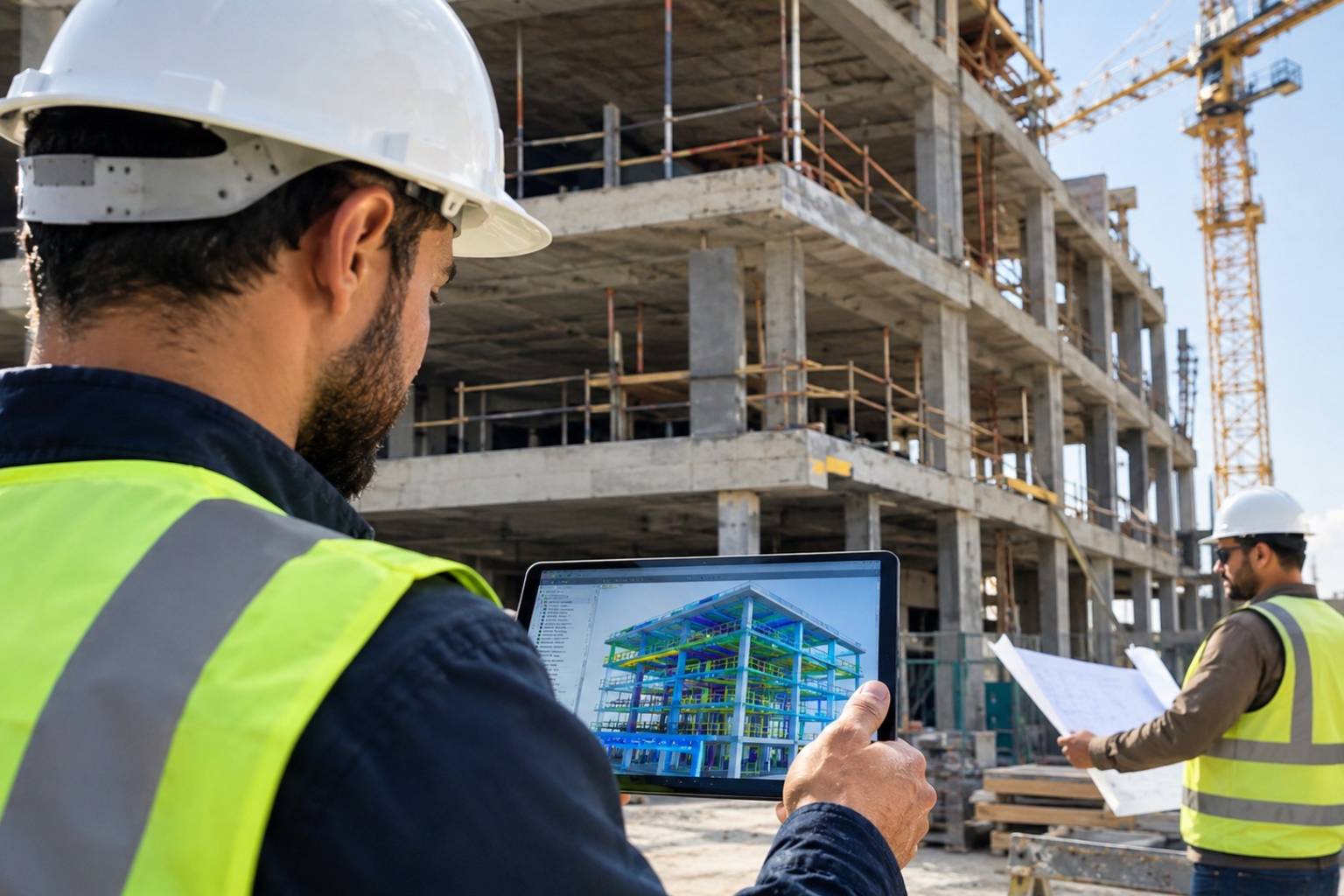
What's the process of LOD?
Model reliability is not clear in traditional design documentation. By defining LOD for each stage of the project, ambiguity is removed so that everyone understands the exact level of detail and accuracy that a model element has before they act on it.
Advantages of LOD in Green Building
- Speed up project delivery
- Better design and coordination planning
- Clash Detection
- Savings in costs
- Effectiveness of the Facilities Management
- Fabrication & Installation Support
- Documentation and Rehabilitation As-Built.
Clear expectations for LOD reduce rework and help with design, coordination, and construction.
A typical LOD matrix allows construction stakeholders to identify potential conflicts and information gaps before construction.
Pro Clash detection at LOD 300 and higher allows project teams to avoid costly conflicts on site between architectural, structural, and MEP systems.
This ensures that the LOD fits the real project needs, avoiding extra modeling work, design changes, and total project costs.
With LOD 500 models, owners and facility managers have credible, verified information at their fingertips to plan maintenance, track assets, and manage life cycles.
LOD 400 gives fabricators and contractors the confidence to develop shop drawings and pre-fabricated components.
The LOD 500 is usually extracted from the point cloud data and contains the verified as-built data, which allows the accurate planning of renovation and restoration. Selecting the appropriate LOD depends on project objectives, budget, and intended use of the BIM model.
Problems of implementing LOD
The benefits are huge, but there are a number of challenges that could crop up:
- 1. Stakeholder agreement on LOD required per phase
- 2. Over model elements not required at a project stage
- 3. Badly modeled elements that require costly rework later on
- 4. shortage of qualified BIM professionals to apply regular LOD standards
- 5. Large, multi-disciplinary projects require precision in applying LOD standards.
These challenges can be efficiently overcome with right planning, clear LOD matrix and experienced BIM specialist.
Overview
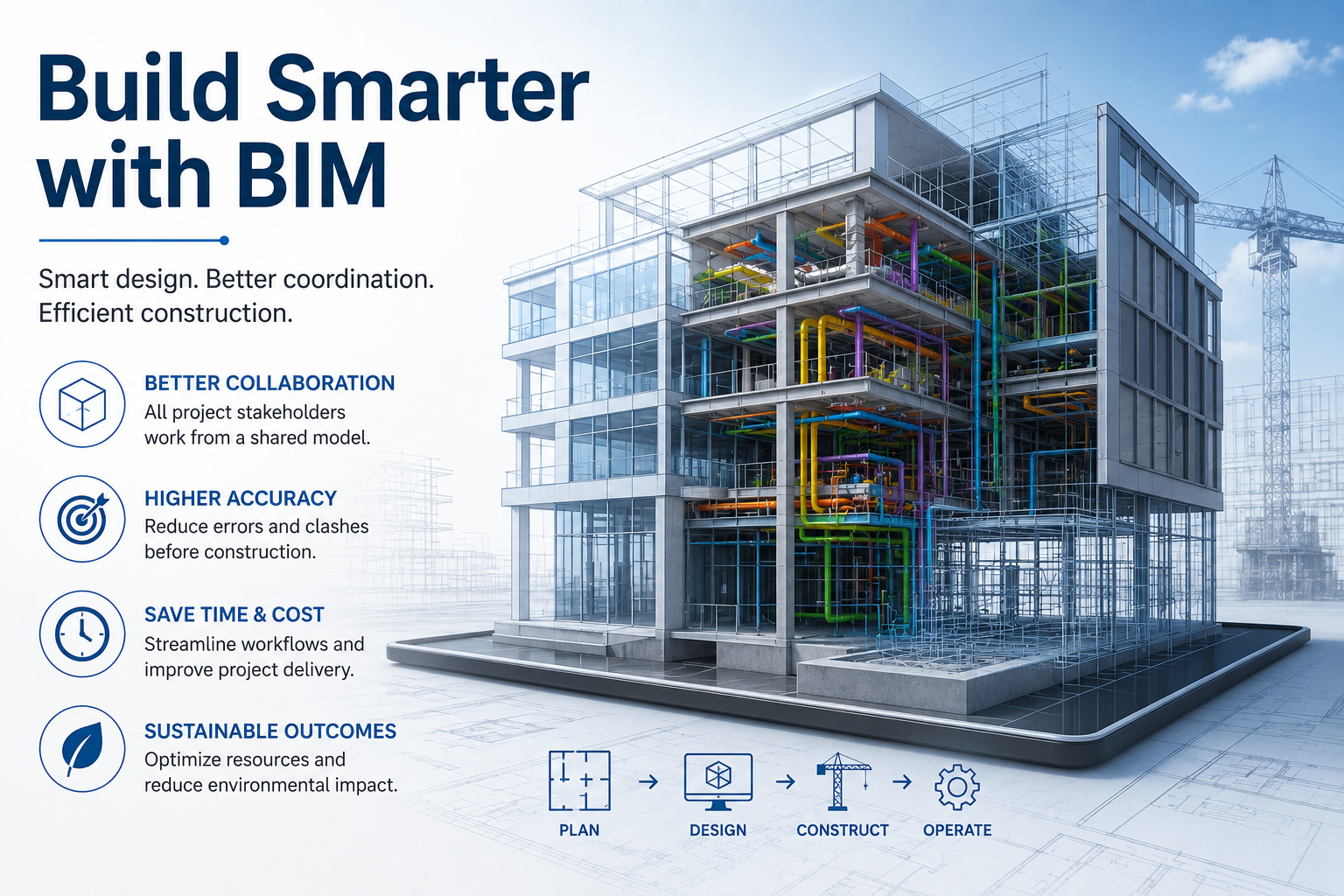
Today's construction, renovation, infrastructure and facility management projects are based on the concept of the level of development. Better for the project, better for accuracy, better for the cost, better for the coordination of project teams is to define the reliability of the model at each step.
As BIM workflows evolve to produce more intelligent, efficient and sustainable built environments, LOD will remain a critical consideration.
With increasing project complexity, the need for well-defined model accuracy is increasing. In the world of BIM, LOD is the bridge between design intent and project reality, creating BIM models that are reliable, data-rich tools throughout the project.
Leave a Reply
Your email address will not be published.